Know Your Needles - Sewing & Embroidery Machine Needle Guide
Sewing & Embroidery Machine Needle Guide
We only stock high-quality, domestic machine needles by Schmetz, but did you know that there are different needles types for different projects? From ballpoint to quilting, microtex to jeans, we have got you covered.
The first thing to know is which type to use depending on fabric, and then whether you are sewing or embroidering, and also consider thread choices! Then, we move onto sizing – needles come in various sizes, or thicknesses, which one you use is determined by the fabric you are sewing.
There are also needles for decorative finishes, such as twin, double-eye or hemstitch needles.
We stock a fantastic range at Lords Sewing to suit all your sewing needs.
It is amazing the difference that can be made to your sewing by using the correct needle type.
Dropping stitches? Breaking thread? It is likely that the cause is the wrong needle is being used.
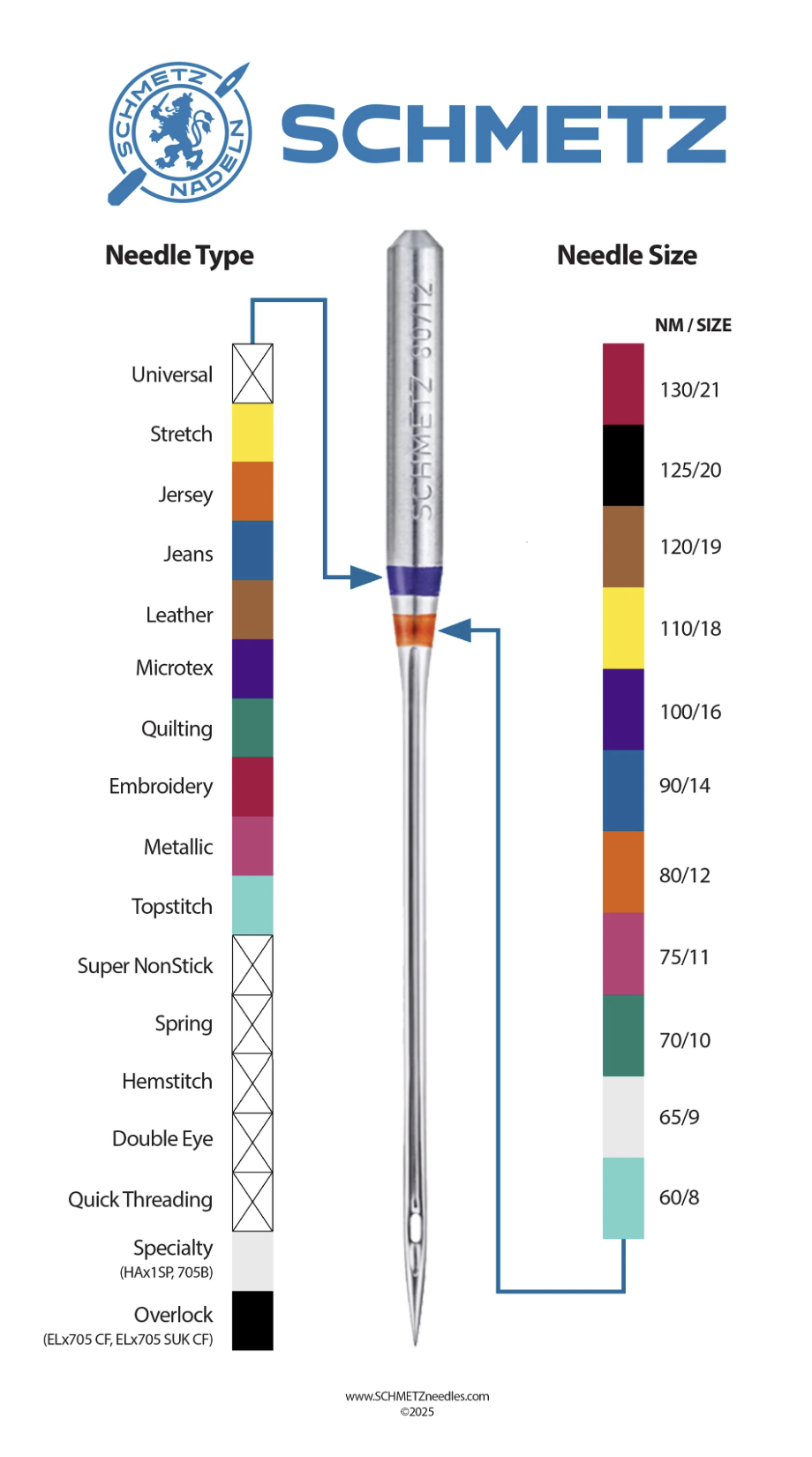
Needles have colour codes to indicate the type and size. The top colour is the type and the bottom colour is the size.
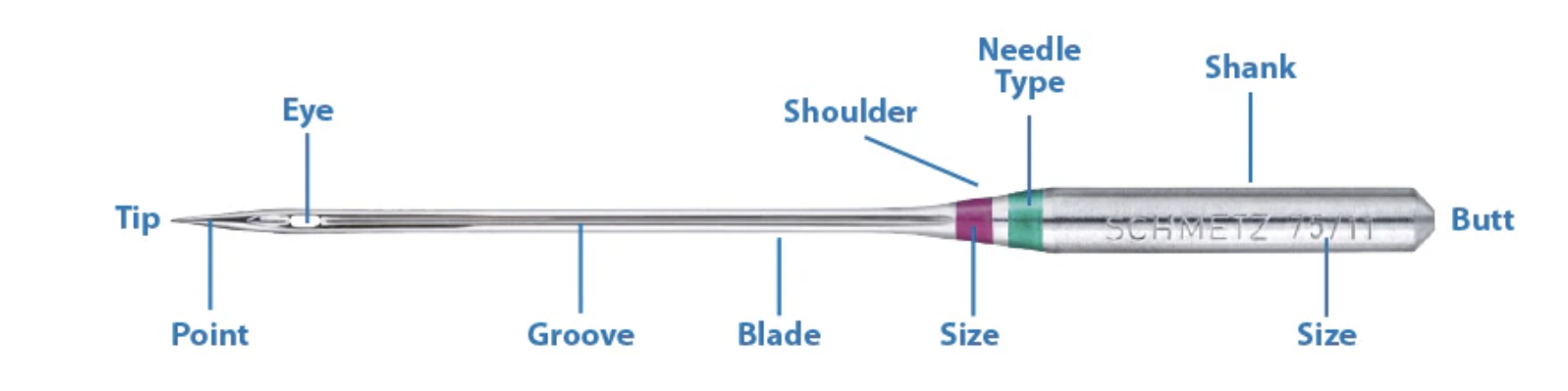
Machine Needle Types:
Universal: Suitable for stable, matte-finish, non-stretch fabrics such as woven cotton, polyester and even felt. Universal needles have NO colour code.
Super Universal: These needles have a smooth, non-stick coating, making them ideal for sewing fabrics with a coated surface, such as oilcloth or waxed cottons, fabrics that have been used with spray-adhesives, or trims with self-adhesive, such as sticky hook-and-loop tape. Super Universal needles have a no colour code but the non-stick coating makes them a DARK GREY colour instead of silver.
Ballpoint: Also known as a Jersey needle – suitable for knitted fabrics such as t-shirt jersey or sweatshirt material. Jersey needles have an ORANGE colour code.
Stretch: A Stretch needle is used for stretchy fabrics with elastic content, e.g. Lycra and activewear fabrics. Also suitable for stretch velvet and lace. These needles have a special eye and scarf shape to prevent skipped stitches. Stretch needles have a YELLOW colour code.
Jeans: Suitable for denim and other thicker, heavier fabrics such as upholstery fabrics. They have a reinforced blade tip to reduce deflection and avoid needle breakage. Jeans needles have a DARK BLUE colour code.
Microtex: This needle has a finer point, making it easier to penetrate finely woven fabric likely to pucker/pull, such as shiny silks and satins, or dense fabrics, like coated vinyl, synthetic leather and foiled fabrics. Microtex needles have a PURPLE colour code.
Leather: With a cutting blade point for leather and hard synthetic materials. Leather needles have a DARK BROWN colour code.
Quilting: A slightly tapered and rounded point allows these needles to penetrate through thick yet soft layers of quilts. Quilting needles have a DARK GREEN colour code.
Topstitch: The needles have a very long eye compared to Universal needles to allow use for thicker, decorative threads. Topstitch needles have a LIGHT BLUE colour code.
Metallic: Similar to Topstitch needles, these have a longer eye and prevent metallic threads from shredding when doing decorative stitching or machine embroidery. Metallic needles have a PINK colour code.
Embroidery: An Embroidery needle has a light ball point, a wider eye to allow finer embroidery threads to pass through without shredding or breaking. Embroidery needles are used for machine embroidery, and unlike sewing, when you change the needle to suit the fabric type, you can use Embroidery needles for all fabrics when machine embroidering. Embroidery needles have a RED colour code.
Gold Embroidery: The same design as an Embroidery needle but with a titanium-nitride coating to provide longevity. Ideal for embroidering designs with high stitch counts. Gold Embroidery needles have a no colour code but are GOLD PLATED.
Twin: Available in different widths, Twin needles have one shank with two needles attached, allowing for the use of two thread at once. These needles come in a universal or stretch point type, and can be used for hems, decorative stitching and pin tucks.
Hemstitch: They have a wing-like blade that pushes the material to the side for decorative finishes on loosely woven fabrics.
Double Eye: With two eyes to use with two thread at one time.
Quick Threading: Universal needle with a small slot on one side of the eye, allowing the thread to slide into the eye.
Needle Sizes:
The higher the number, the thicker/heavier the needle. Starting at a 60/8 for very thin, lightweight fabric, going up to a size 130/21 for very heavy fabrics. A size 80/12 is an average size for medium weight fabrics. Most new domestic sewing machines come with a size 90/14 universal needle fitted and new domestic embroidery machines come with a size 75/11 embroidery needle fitted.
As with needle types, needle sizes are also indicated with a colour code. Here are the colour codes for the needle sizes that we stock. Some needle types have limited sizes available and not the full range.
Size 60/8 = LIGHT BLUE
Size 70/10 = GREEN
Size 75/11 = PINK
Size 80/12 = ORANGE
Size 90/14 = DARK BLUE
Size 100/16 = PURPLE
Size 110/18 = YELLOW